Dynamic Sustainability Report, sustainability reporting software and VSME software

The sustainability reporting software that helps SMEs and ESG consultants produce VSME reports and manage ESG data in an orderly way.

Why collect sustainability data?

Voluntary Sustainability Declaration
(VSME Standards)

Document for Sustainability Dialogue between SMEs and Banks

Credit Reports & Corporate Resilience

EU Environmental Taxonomy

How is sustainability data collected?

Dynamic Sustainability Report is a SaaS platform designed to simplify and optimize the voluntary sustainability reporting process, reducing time, costs, and complexity.

Optimize your reporting process

The solution guides users in collecting ESG information, taking into account national feautures, to prepare the voluntary sustainability declaration according to European or national guidelines.
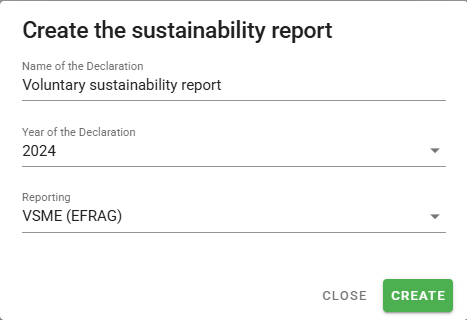
Optimize your reporting process

Voluntary Sustainability Declaration (VSME Standards)

Through the modular approach, it is possible to prepare your voluntary sustainability declaration for each thematic area:
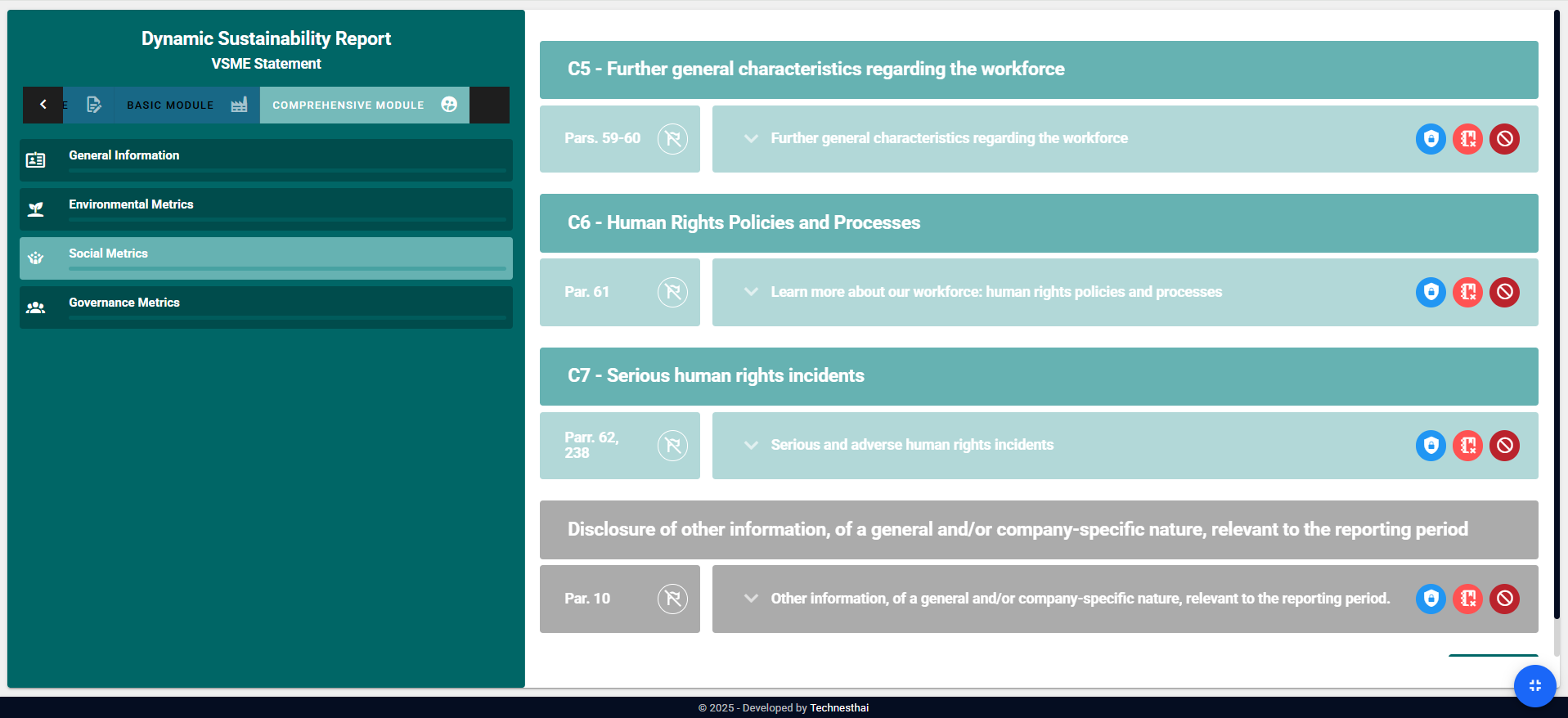
  • General Information
  • Environmental Metrics
  • Social Metrics
  • Governance Metrics
Voluntary Sustainability Declaration (VSME Standards)

Sustainability Dialogue between SMEs and Banks

The application supports users in completing ESG information according to the thematic areas defined by the Sustainable Finance Committee:
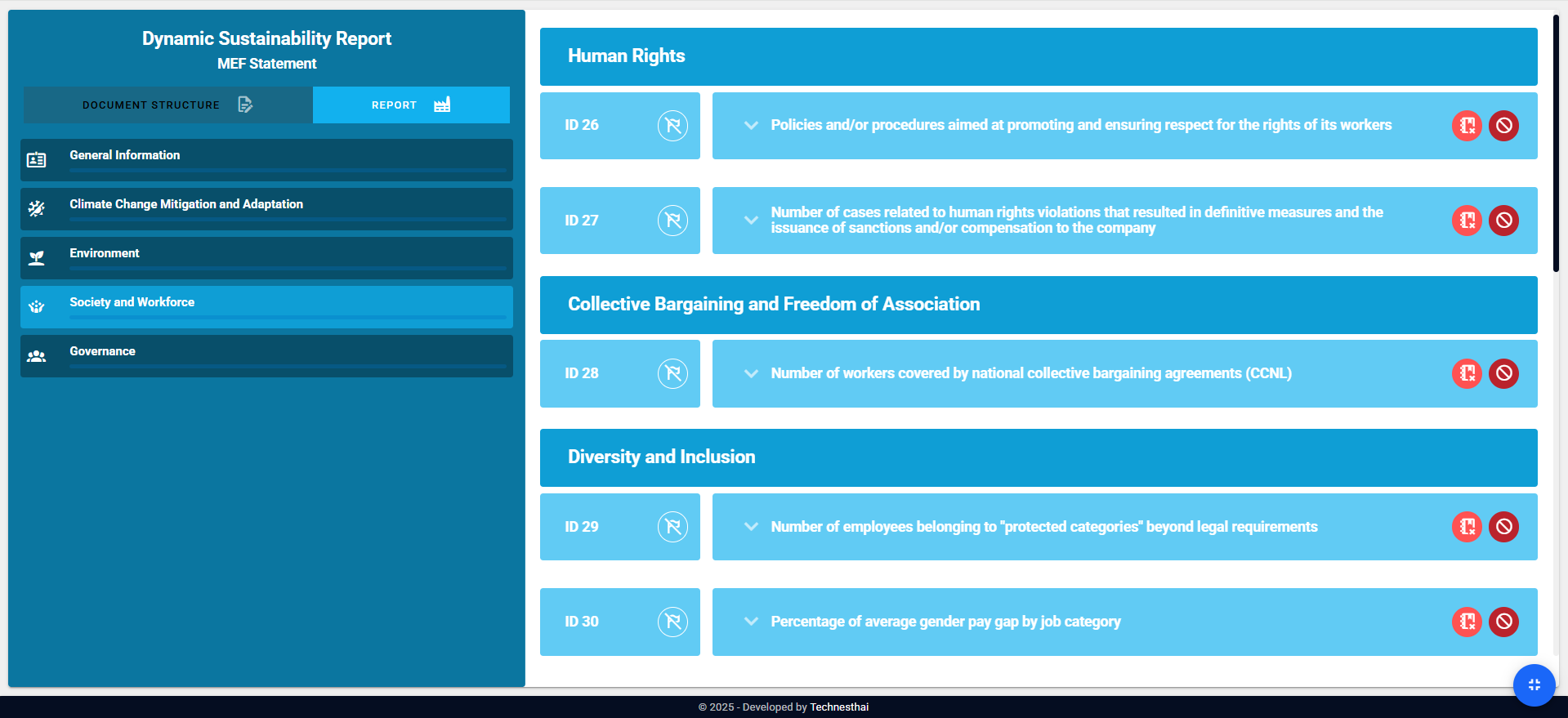
  • General Information
  • Climate Change Mitigation and Adaptation
  • Environment
  • Society and Workforce
  • Business Conduct
Sustainability Dialogue between SMEs and Banks
01

SME sustainability report

An SME sustainability report brings together environmental, social and governance information in one document that can be shared with customers, banks, investors and supply chain partners.

02

ESG software for SMEs

For companies without a dedicated in-house team, ESG software for SMEs helps organize requests, data sources, methodological notes and final outputs in a more orderly and verifiable workflow.

03

What the VSME standard is

The VSME standard is the voluntary reference developed by EFRAG for sustainability reporting by unlisted SMEs and micro-enterprises, with an approach that is more proportionate than the full ESRS framework.

04

Difference between VSME and ESRS

The difference between VSME and ESRS lies above all in proportionality: VSME is designed for unlisted SMEs with lighter information requirements, while ESRS responds to the full obligations of the CSRD.

Try our product now

Contact us for a free demo.

Request a demo

Use Cases

Dynamic Sustainability Report is a tool designed to support SMEs and ESG consultants in various application areas. Below are some examples of use.

Value Chain

Companies subject to the CSRD Directive have a regulatory obligation to collect sustainability information also from micro and small-medium enterprises (SMEs) in their supply chain, even though these are not required to provide mandatory reporting.

Benefici

Reduction of operational and reputational risk

Reduction in the time needed to prepare the voluntary sustainability statement

Increased efficiency in data sharing

Alignment with the main Italian and European guidelines

Access to Credit

Micro and small-medium enterprises that submit a voluntary sustainability statement can more easily access subsidized financing or dedicated funds and obtain better economic conditions in terms of interest rates applied.

Benefici

More effective communication with financial institutions

Increased likelihood of a positive credit decision

Improved economic conditions applied to credit

Compliance with main Italian and European best practices

Reputation and Business Opportunities

A voluntary sustainability statement strengthens the reputation of micro and small-medium enterprises, making them more attractive to clients, business partners, and investors.

Benefici

Strengthening of competitive position and creation of new business opportunities

Increased customer loyalty

Development of new strategic partnerships

Creation of competitive advantages through sustainable practices

Impact on Corporate Strategy

Micro and small-medium enterprises that adopt a structured approach to sustainability are more resilient to external risks and market shocks.

Benefici

Reduction in energy costs

Efficient use of company resources

Reduction in employee turnover

Increased corporate attractiveness

European Union Taxonomy

The EU Taxonomy solution allows companies of any size to verify the environmental sustainability level of their economic activities according to EU regulations and to make sustainable investment decisions. Using their ATECO code, companies can consult environmental objectives and, through a dichotomous questionnaire, collect information quickly and easily, supporting them in their reporting obligations.
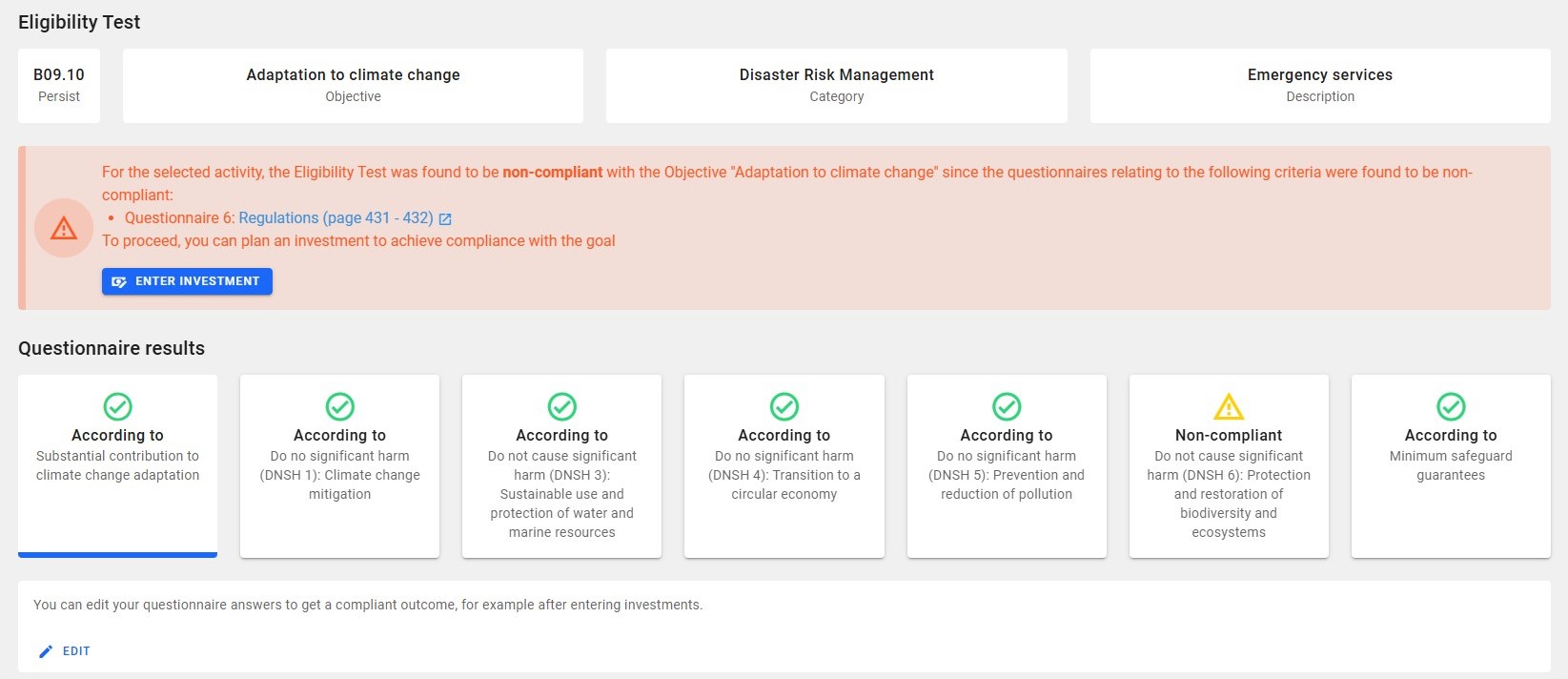
European Union Taxonomy

Frequently asked questions

The VSME (Voluntary Sustainability Reporting Standard for non-listed SMEs) is the voluntary sustainability reporting standard developed by EFRAG for unlisted small and medium-sized enterprises and micro-enterprises. The European Commission adopted it with Recommendation (EU) 2025/1710 of 30 July 2025, inviting SMEs excluded from CSRD obligations (Directive (EU) 2022/2464) to use it to communicate environmental, social and governance information in a structured way. VSME is designed as a proportionate framework for companies with up to 1,000 employees that receive ESG information requests from banks, customers or supply-chain partners. Technesthai's Dynamic Sustainability Report (DSR) fully implements the standard through modular questionnaires and automates the production of the final report.

Dynamic Sustainability Report (DSR) is Technesthai's SaaS platform for preparing sustainability reports according to the VSME standard (Voluntary Sustainability Reporting Standard for non-listed SMEs). It guides companies through the collection of ESG information using a structured checklist and a semi-automated completion flow, supported by artificial intelligence components that pre-populate the qualitative sections of the report. DSR is designed for unlisted SMEs and micro-enterprises that receive sustainability reporting requests from banks, customers or value-chain partners, as well as for ESG consultants who support them. The product returns a compliant VSME report, ready to be shared with stakeholders or submitted to voluntary assurance.

VSME and ESRS (European Sustainability Reporting Standards) are both developed by EFRAG, but they address different needs. ESRS are the mandatory standard for companies subject to the CSRD (Directive (EU) 2022/2464): they require an in-depth double materiality assessment, alignment with the EU Taxonomy (Regulation (EU) 2020/852) and more than one thousand potential datapoints. VSME is a much leaner voluntary standard, structured around a basic module and a comprehensive module, proportionate to the information capacity of unlisted SMEs. For a company with up to 1,000 employees, VSME covers the typical requests from banks and supply-chain customers with a significantly lower reporting burden. Dynamic Sustainability Report (DSR) natively supports the VSME standard.

Unlisted SMEs are increasingly subject to ESG information requests from banks, large corporate customers and supply-chain partners. Banks request sustainability data during credit assessment to align with the EBA Guidelines on loan origination and monitoring (EBA/GL/2020/06); large companies subject to the CSRD must collect information along the value chain and tend to pass the request on to smaller suppliers. Publishing a VSME report means responding to these requests with a single, standardized and comparable document, avoiding the need to complete dozens of different questionnaires. Dynamic Sustainability Report (DSR) allows SMEs to build this report through a guided process, even without a dedicated ESG team.

VSME requires information across three areas: environmental (energy consumption, greenhouse gas emissions, water use, waste), social (workforce, health and safety, training, gender equality, remuneration) and governance (ownership structure, anti-corruption policies, sanctions). The basic module covers the essential indicators; the comprehensive module adds information typically requested by banks, such as selected Scope 3 emissions, and by companies subject to the CSRD along the value chain. Dynamic Sustainability Report (DSR) provides a pre-arranged checklist of the required data and progressively collects information through modular forms, indicating the typical internal source for each item (utility bill, payroll records, injury register). This reduces data search time and completion errors.

Yes. Most Italian micro-enterprises and small businesses do not have a sustainability manager or dedicated ESG team: reporting is typically handled by the CFO, quality manager or an external consultant. Dynamic Sustainability Report (DSR) is designed precisely for this user profile: completion is guided, questionnaires are in Italian, and each VSME datapoint includes an explanatory note clarifying its meaning. Artificial intelligence components pre-fill qualitative sections based on context information provided by the company. An external consultant can work in multi-client mode on the same platform, managing several ESG mandates with a single license.

The EBA Guidelines on loan origination and monitoring (EBA/GL/2020/06) require European banks to integrate ESG factors into credit assessment and portfolio risk monitoring. To apply these guidelines to SME lending, institutions ask customers for sustainability information, often through proprietary questionnaires that differ from bank to bank. A standardized VSME report makes it possible to respond to all these requests with a single document, reducing administrative burden and improving the perceived quality of information during the assessment process. Dynamic Sustainability Report (DSR) produces a report in the European-recognized VSME format, ready to be attached to credit applications.

The time required depends on the internal availability of data and the selected module (basic or comprehensive). For a company with basic data already consolidated (energy consumption, workforce, financial statements), completing the basic module in Dynamic Sustainability Report (DSR) typically takes a few days distributed over two or three weeks, with most of the time dedicated to data collection rather than drafting. The comprehensive module adds time for estimating Scope 3 emissions along the value chain, which is the most demanding section. DSR's guided checklist and AI pre-completion of qualitative sections significantly reduce the time required compared with manual report drafting.